


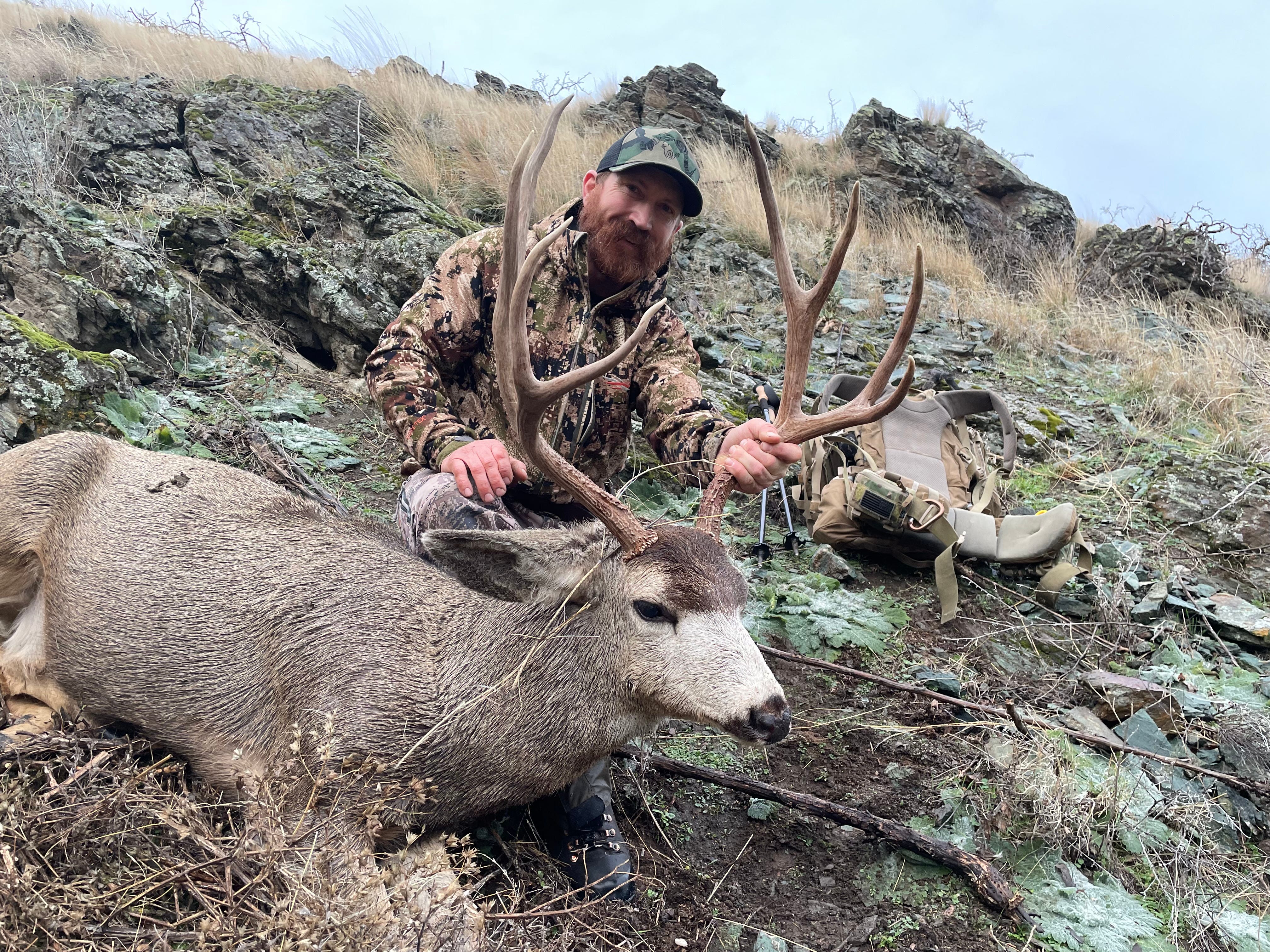
Delaware’s deer season opened Sept. 1 under emergency regulations the state had never needed before. Its first case of chronic wasting disease turned up this spring, in a deer a hunter shot and submitted for testing; by mid-August the wildlife agency had drawn a management zone, expanded sampling, and was asking hunters to accept new rules on two weeks’ notice. Thirty-seven states and five Canadian provinces have now had the same problem.
Over the course of 2024, our research team spent months compiling the most up-to-date dataset on Chronic Wasting Disease response policy in North America. We reviewed wildlife agency regulations, press releases, legislative proposals, management plans, and public communications across every U.S. state and Canadian province with CWD in wild herds of deer, elk, or moose populations. We ultimately published the work in The Wildlife Society’s premier journal, Wildlife Society Bulletin, because we felt there was a major gap in understanding not just the biology of CWD, but the politics and management systems surrounding it in the present day.
Most conversations about CWD focus on the disease itself, topics like the prions, the testing protocols, the spread maps, and so on. But what we found was that CWD is increasingly reshaping the entire wildlife management landscape across North America. One of the clearest findings from our work was that wildlife agencies are no longer simply managing deer populations. They are now managing communications strategies, public trust, political conflict with elected politicians, and cultural divisions surrounding hunting itself.
Across nearly every state and Canadian province we studied, agencies were heavily focused on communicating with hunters. In fact, one of the most consistent themes we found was that wildlife managers are trying to convince hunters to actively participate in disease surveillance by submitting samples, following carcass transport rules, and adapting to new regulations. That matters because modern CWD management depends heavily on hunters cooperating with agencies. Hunters are the primary source of samples that allow states to track disease spread and prevalence. Without hunter participation, agencies are essentially flying blind.
What was interesting to us was how different states approached the challenge of gaining hunter trust so samples would be submitted. Some states focused heavily on education campaigns explaining why testing matters. Others offered incentives like free tags or reimbursement for meat processing if a deer tested positive. (The buck in the article image was taken on one of these disease management hunts.) Several states invested heavily in online dashboards and mapping tools showing where CWD was spreading in real time. Some states found themselves desperately trying to design communications to fight off influencers spreading false narratives, such as the disease being exaggerated to end hunting altogether.
But the deeper we got into the research, the more obvious it became that many CWD debates are no longer really about science alone. The biggest flashpoint across North America was baiting and feeding bans. From a wildlife disease standpoint, especially a disease that spreads via dense groups of deer, the reasoning is fairly straightforward: concentrating deer unnaturally around bait piles or feeding sites increases opportunities for disease transmission. As a result, baiting and feeding bans have become one of the most common management tools used by agencies. But culturally and politically, those bans are explosive in some regions.
In several states, lawmakers introduced legislation specifically designed to block wildlife agencies from implementing baiting bans. Some politicians argued agencies were overstepping their authority or ignoring the traditions and values of hunters and landowners in their states.
What we found is that this tension represents something much larger happening in wildlife management right now. Historically, wildlife agencies and commissions were largely trusted to make technical management decisions using science, public comment processes, and long-standing wildlife governance systems. Increasingly, however, elected politicians are stepping directly into wildlife management debates. In some cases, that political involvement supports agencies. In others, it directly challenges them. In a few cases, political involvement seeks to destroy agencies altogether.
One of the more surprising findings from our study involved legislative proposals surrounding genetically “CWD-resistant” deer. In states like Indiana and Oklahoma, lawmakers proposed releasing selectively bred deer into wild populations in hopes of reducing disease impacts. Scientists remain deeply divided on whether this approach is realistic or safe for wild herds, but the proposals gained attention because they sounded like a quick technological fix to a difficult problem. These types of solutions are great for politicians trying to make a name for themselves, but terrible for wildlife managers who will have to follow these harebrained schemes if one of them succeeds.
We also found examples where legislators attempted to weaken, restructure, or even destroy wildlife agency authority entirely. In Texas, political fights over CWD escalated to the point where lawmakers introduced proposals targeting the authority of the state wildlife agency itself. Other states explored shifting deer management authority toward agricultural agencies, effectively treating cervids more like livestock. Conflicts of interests where lawmakers had major ties to the captive cervid industry were rarely disclosed in these examples.
For us as researchers, one of the biggest takeaways was that CWD policy is increasingly becoming a test of agency trust. Hunters often feel frustrated by new regulations, carcass rules, testing requirements, or baiting restrictions. At the same time, wildlife managers are facing a disease that is fatal, difficult to contain, environmentally persistent, and spreading geographically.
The agencies that appear to be navigating this challenge most successfully are generally not the ones simply imposing the most regulations. They are the agencies communicating clearly, involving hunters early, explaining the scientific reasoning behind management actions, and building long-term relationships with local communities.
Ultimately, our research suggests that the future of CWD management may depend just as much on communication and public trust as it does on biology. For hunters and outdoorsmen, this issue matters far beyond deer disease itself. The debates surrounding CWD are increasingly shaping how wildlife agencies function, how conservation decisions are made, and how much trust exists between the public and the institutions responsible for managing wildlife in North America.
Our research team involved a wide range of people, including everyone from wildlife biologists, to hunting organizations, to policy specialists, to disease ecologists, to Native Indian scholars to make sure it was neutral and open to all perspectives. We want to challenge the politicization of scholarly research and produce peer reviewed work that is trusted by a wider range of scholars and practitioners. If you’d like to read our paper, access is free and open, and the URL is here: https://wildlife.onlinelibrary.wiley.com/doi/full/10.1002/wsb.70028
Interesting read.
I won't pretend to understand the whole debate surrounding CWD and wildlife agencies. I have never been a hunter, so it's very much outside my purview.
That said, the notion of introducing genetically engineered "CWD resistant" cervids into the extant populations raises red flags. We don't have a good track record of changing already existing ecosystems by introducing new species or new variants of old species.